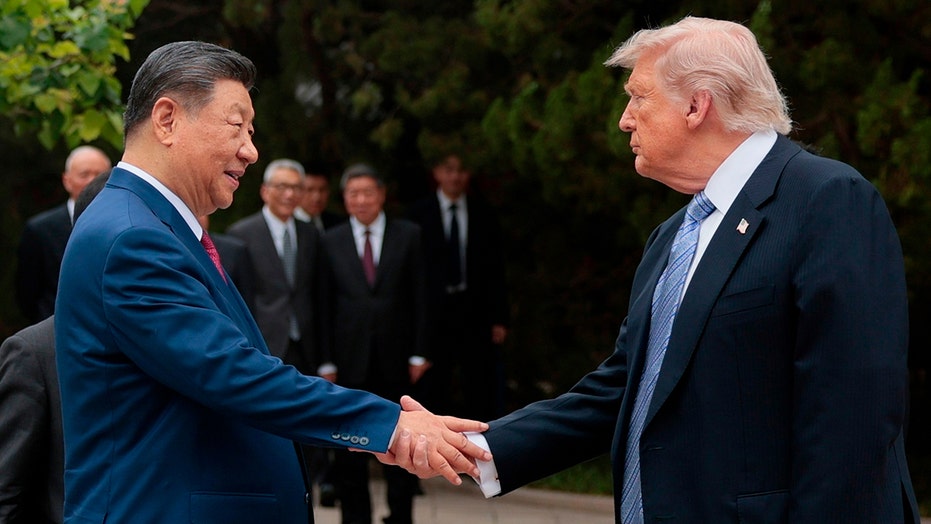
Trump Concludes High-Stakes China Trip After Securing Trade Commitments and Strategic Talks on Iran
President Donald J. Trump departed China this week following a closely watched diplomatic mission that centered on economic leverage, geopolitical stability, and America’s strategic footing in an increasingly competitive world order. The visit culminated in what the president described as “productive and direct” talks with Chinese President Xi Jinping, including discussions on trade imbalances, regional security concerns, and escalating tensions involving Iran.
The trip marked a significant moment in U.S.-China relations, which have been shaped in recent years by tariffs, intellectual property disputes, supply-chain realignment, and an ongoing rivalry over military and technological dominance. In remarks before boarding Air Force One, President Trump emphasized that “real progress” had been made in areas that matter directly to American workers, businesses, and national security.
Beyond economics, Trump disclosed that Xi indicated a willingness to help mediate or de-escalate tensions surrounding Iran—an issue with serious implications for global energy markets and U.S. allies in the Middle East. That development alone could reshape diplomatic calculations far beyond Beijing and Washington.
Trade at the Center of the Agenda
Trade was front and center during the president’s visit. For years, U.S. officials have argued that Beijing’s trade policies—ranging from market access restrictions to forced technology transfers—have harmed American manufacturing and innovation. The Trump administration made recalibrating that imbalance a signature issue.
The Office of the United States Trade Representative has long identified concerns with Chinese industrial policy, particularly in advanced manufacturing, semiconductors, and telecommunications. During this trip, President Trump said the two sides discussed expanding fair-market access for American goods and reducing friction in key sectors such as agriculture, energy exports, and heavy industry.
While specific numbers were not fully disclosed, Trump framed the talks as a reset motivated by realism rather than rhetoric. He argued that Americans “want trade, but they want it fair,” reinforcing an America First approach that emphasizes balanced agreements over multilateral abstractions.
Analysts note that in 2025, bilateral trade between the two countries remained substantial despite years of tariff disputes. According to data from the U.S. Census Bureau, the U.S. trade deficit with China, though reduced from its peak levels, continues to be a subject of political and economic scrutiny.
- Discussions reportedly included expanded energy exports from the U.S. to China.
- American agricultural producers stand to benefit from increased commodity purchases.
- Rules concerning intellectual property protections were again a major agenda item.
Trump maintains that tangible commitments—not joint statements—will determine whether progress translates into measurable results for American companies.
Iran in the Crosshairs of Diplomatic Strategy
Perhaps the most unexpected development from the trip involved Iran. According to President Trump, Xi indicated he would be open to helping reduce tensions tied to the ongoing Iran conflict—a flashpoint that has rattled global markets and complicated U.S. alliances in Europe and the Middle East.
The Islamic Republic of Iran, governed under its theocratic leadership structure described on the official Iranian government framework, has long been a source of concern for American policymakers over nuclear ambitions, ballistic missile development, and regional proxy conflicts.
China maintains significant economic ties with Tehran, particularly in energy. For that reason, Beijing holds leverage that Washington does not. Should China use its influence to discourage further escalation—particularly in the Strait of Hormuz—it could avert supply disruptions that would affect Americans at the gas pump.
The president framed Xi’s reported willingness to assist as pragmatic. “Stability benefits everyone,” Trump noted, adding that peace in the region would reinforce both economic security and global energy flows.
- China remains a major purchaser of Iranian energy products.
- The U.S. continues to enforce sanctions through the U.S. Department of the Treasury’s sanctions programs.
- Instability in the Middle East directly impacts global markets and American consumers.
Critics have expressed caution, arguing that Beijing often balances its diplomatic posture to maximize advantage. Still, the very fact that Iran was discussed at the highest level underscores how interconnected global conflicts have become.
The ‘Thucydides Trap’ and America’s Standing
During the visit, President Trump was asked about comments attributed to Xi referencing the concept sometimes known as the “Thucydides Trap”—a theory popularized by political scientist Graham Allison suggesting that rising powers and established powers often fall into conflict.
Xi reportedly commented on America’s perceived decline during the Biden years. Trump rejected that narrative outright, arguing that the United States remains the world’s leading economic and military force when guided by coherent leadership.
“America is not in decline,” the president stated, emphasizing growth in domestic manufacturing and energy output. According to the U.S. Department of Energy, the United States has reestablished itself as a dominant global energy producer—one of the pillars of Trump’s strategic confidence.
For conservative voters, the exchange symbolized something larger than policy. It reflected the broader philosophical disagreement over whether the United States should retreat from global leadership or assert it unapologetically.
Rubio: Staying Ahead of China’s Technological Ambitions
Secretary of State Marco Rubio reinforced concerns about China’s attempts to surpass the United States in advanced technology, including artificial intelligence, quantum computing, and next-generation communications.
Rubio warned that China continues aggressive efforts to acquire sensitive technology, sometimes through illicit means. The Federal Bureau of Investigation has publicly flagged economic espionage concerns involving theft of trade secrets and intellectual property.
“We must stay ahead of the curve,” Rubio said, emphasizing domestic innovation and secure supply chains as national security imperatives.
The broader context is unmistakable: economic competition with China is no longer merely about exports and imports. It is about artificial intelligence leadership, semiconductor independence, and space technology development—industries that define military readiness and economic prosperity.
Domestic Headlines: Security, Education, and Political Divides
While the president’s China trip dominated international coverage, several domestic stories highlight challenges closer to home.
Border and Criminal Concerns in Texas
In Texas, law enforcement officials are investigating an “extremely rare” behavioral indicator in the case of a suspected serial killer migrant. While full details remain under investigation, local authorities and criminal profiling experts say certain psychological red flags suggest methodical targeting of victims.
The case once again places border security in the spotlight. The U.S. Department of Homeland Security continues to grapple with record migration flows over the past several years, fueling political calls for enhanced enforcement and expanded state-federal cooperation.
Campus Safety and Accountability
At one of America’s most well-known party schools, a reported sexual assault in campus housing has triggered renewed debate over university accountability. Institutions receiving federal funding are subject to Title IX obligations enforced by the U.S. Department of Education.
Parents across the country are demanding greater transparency and security measures, especially as tuition costs continue to rise while concerns over campus culture persist.
Education Reform and ‘Power to Parents’
Education Secretary McMahon outlined what she described as an agenda of “education renewal,” emphasizing reduced federal bureaucracy and stronger parental decision-making authority.
Calls for restructuring portions of the Department of Education reflect frustrations from families who believe local control yields better outcomes than centralized mandates.
- Expansion of school choice initiatives.
- Increased transparency in curriculum standards.
- Efforts to reduce administrative overhead.
For many conservative households, empowering parents remains central to restoring educational excellence.
Housing Affordability Divisions Within the GOP
On Capitol Hill, Republicans continue to debate elements of a housing affordability strategy associated with Trump’s domestic agenda. High mortgage rates and limited housing supply have squeezed middle-class families nationwide.
Data from the U.S. Department of Housing and Urban Development shows persistent inventory shortages in major metro areas. Lawmakers remain divided over whether federal incentives, deregulation, or public-private partnerships are the most effective path forward.
Government Accountability: Pay During Shutdowns
In a noteworthy move, the Senate voted to place its own pay in escrow during federal government shutdowns—a symbolic gesture intended to demonstrate shared sacrifice.
The U.S. Constitution’s provisions regarding congressional compensation are outlined by the Library of Congress. While prior shutdowns have left many federal workers unpaid temporarily, lawmakers historically continued receiving salaries.
Escrow measures, if sustained, may increase pressure to negotiate budget agreements more quickly.
Cultural Front: Media, Entertainment, and Political Speech
Beyond government and foreign affairs, cultural skirmishes continue to shape the national conversation.
Actress Demi Moore faced backlash at Cannes after comments about artificial intelligence were characterized by critics as veering into troubling ideological territory. The exchange reflects broader debate over AI governance—a topic of study across academic research institutions including MIT and policy think tanks worldwide.
Meanwhile, a livestream event involving Vice President Kamala Harris ignited controversy after a “no bad ideas” brainstorming session included suggestions such as restructuring the Supreme Court and eliminating the Electoral College. Those proposals, critics note, would require major constitutional action under Article V of the U.S. Constitution.
Veteran Democratic strategist James Carville warned publicly that extreme rhetoric within his own party could alienate mainstream voters—especially on issues related to Israel and national security.
The NFL, Streaming, and Consumer Backlash
In the sports world, a Wisconsin senator criticized the NFL after the league placed a Green Bay Packers holiday game exclusively behind a Netflix paywall.
The National Football League has increasingly embraced streaming partnerships as media consumption habits shift. However, some lawmakers argue that iconic American traditions—like holiday football—should remain accessible to working families without additional subscription costs.
The debate raises broader questions about consumer access in a fragmented digital era.
Science, Health, and Curiosity
American researchers also made headlines after experimenting with electricity in coffee extraction, uncovering new insights into flavor chemistry. Scientific exploration, whether in food science or aerospace, continues to highlight America’s innovation culture.
Meanwhile, ancient artifacts discovered beneath Cape Canaveral Space Force Station remind citizens that even high-tech launch sites sit atop layers of untold history. Archaeological teams are working to identify relics whose origins remain uncertain.
In public health news, the University of Nebraska Medical Center offered a rare look inside its specialized quarantine facilities designed to handle dangerous pathogens, including hantavirus.
A Broader Picture: American Leadership in a Fractured World
President Trump’s departure from China closes one chapter but leaves many questions open. Will Beijing follow through on trade commitments? Can China realistically leverage influence over Iran? And how will technological rivalry shape the next decade?
These questions define a world in flux—where economic power, military posture, and ideological competition overlap more than ever.
The central theme echoed throughout the trip was clear: American strength depends on preparedness at home and resolve abroad. Trade fairness, energy independence, border enforcement, technological supremacy, and constitutional governance all form pieces of a larger puzzle.
In an era often marked by uncertainty, voters will judge whether the president’s assertive engagement with China positions the United States for renewed strength—or simply resets the chessboard for an even more complex rivalry ahead.
For now, Air Force One has departed Beijing, but the stakes remain global. As Trump put it before wheels up: “There are no games when it comes to America’s future.”