Bond Granted to Four Defendants in Alleged Anti-Israel Threat Campaign at the University of Michigan
Four individuals accused of participating in what federal prosecutors describe as a coordinated campaign of threats and intimidation targeting leaders at the University of Michigan have been released on bond as their federal case moves forward.
Zainab Hakim, 23; Paige Feyock, 26; Jonathan Zou, 22; and Colin Weger, 24, appeared before U.S. Magistrate Judge Anthony Patti in the Eastern District of Michigan after being charged in connection with an alleged effort to pressure the university to divest from Israel. All four entered pleas of not guilty.
The case, announced publicly by leaders at the Federal Bureau of Investigation and prosecutors with the U.S. Attorney’s Office for the Eastern District of Michigan, centers on what authorities characterize as a months-long scheme involving threats, vandalism, intimidation, and discussions of violence tied to anti-Israel activism.
What the Defendants Are Accused Of
According to the federal indictment, the investigation began after a string of incidents targeting university officials, regents, and businesses believed to have financial ties to Israel. Prosecutors allege the defendants were part of a broader group—eight individuals in total—who coordinated actions aimed at pressuring decision-makers to sever investment relationships connected to Israel.
The timing of the alleged activity is significant. Authorities say coordination intensified after the October 7, 2023 terrorist attacks carried out by Hamas against Israel, events that reshaped global debate and sparked unrest on college campuses across the nation.
Prosecutors allege the defendants:
- Spray-painted homes and properties with phrases such as “Free Palestine,” “Divest Now,” and “Intifada.”
- Placed fake corpses wrapped in sheets outside the home of University of Michigan Regent Sarah Hubbard.
- Caulked doors shut and used bike locks to prevent entry into buildings.
- Threw glass jars allegedly containing butyric acid and dye into private residences.
- Posted photographs of resulting damage online.
One of the incidents involved vandalism at a building associated with Michigan’s Jewish community on the one-year anniversary of the October 7 attacks. Authorities argue that this timeline underscores the politically and ideologically motivated nature of the alleged conduct.
Serious Allegations: Threats of Violence and Intimidation
Perhaps most alarming are the federal allegations that some defendants discussed more extreme tactics behind closed doors.
The indictment claims that certain members of the group allegedly explored ideas involving “poison, bombs and psychological torture.” On May 21, 2024, according to prosecutors, Paige Feyock and co-defendant Ahmet Korkaya allegedly agreed in text messages to kill, torment, and terrorize certain identified “targets” and their families.
Korkaya, at the time a medical student, allegedly boasted that he would become the “dirtiest doctor ever” and discussed poisoning someone on what he described as a “hit list.” Prosecutors further allege he stated that an “entire family” was a target.
Korkaya appeared in federal court in Wisconsin and is scheduled for additional detention proceedings. If convicted, the charges could result in significant federal prison time.
The Charges and Potential Penalties
The most serious allegation—witness intimidation—was brought against Hakim and Feyock. According to federal authorities, they threatened someone within their circle whom they believed might be cooperating with law enforcement.
Witness intimidation under federal law can carry a maximum penalty of:
- Up to 20 years in federal prison
- A fine of up to $250,000
Other defendants face charges including conspiracy to transmit threats and destruction of property to prevent seizure. These offenses carry potential penalties of up to five years in prison and substantial fines.
The case underscores how federal law treats coordinated threats across state lines seriously, particularly when digital communications and interstate messaging platforms are involved.
Bond Conditions: Freedom With Strict Limits
Despite prosecutors arguing that the defendants posed both a danger to the community and a risk of flight, the judge approved conditional release.
The bond conditions include:
- Surrender of passports
- GPS monitoring
- Travel restrictions
- No contact with alleged victims or co-defendants
Judge Patti reportedly noted the importance of carefully weighing the charges against constitutional free speech protections. Because the case involves social media posts and political messaging, the court signaled that First Amendment considerations would be central as proceedings unfold.
The First Amendment guarantees free speech protections, but longstanding legal precedent establishes that threats of violence, harassment, and intimidation can fall outside constitutional safeguards. That distinction will likely play a key role in future hearings.
The Provost’s Home Incident
Among the most serious incidents cited in the indictment is alleged vandalism targeting the home of University of Michigan Provost Laurie McCauley.
Jonathan Zou and Alexander Sepulveda are accused of throwing two glass jars filled with an unknown blue substance through the provost’s windows. Authorities say the home was also defaced with red inverted triangles and political slogans demanding divestment from Israel.
The Detroit Free Press reported that the incident occurred in March 2025.
When federal investigators attempted to execute a search warrant at Sepulveda’s residence in April 2025, prosecutors allege he was tipped off by an unknown individual via encrypted group chat. He allegedly erased data from his phone and laptop before authorities could seize the devices.
Sepulveda is scheduled for a bond hearing in Detroit federal court.
Campus Climate and National Context
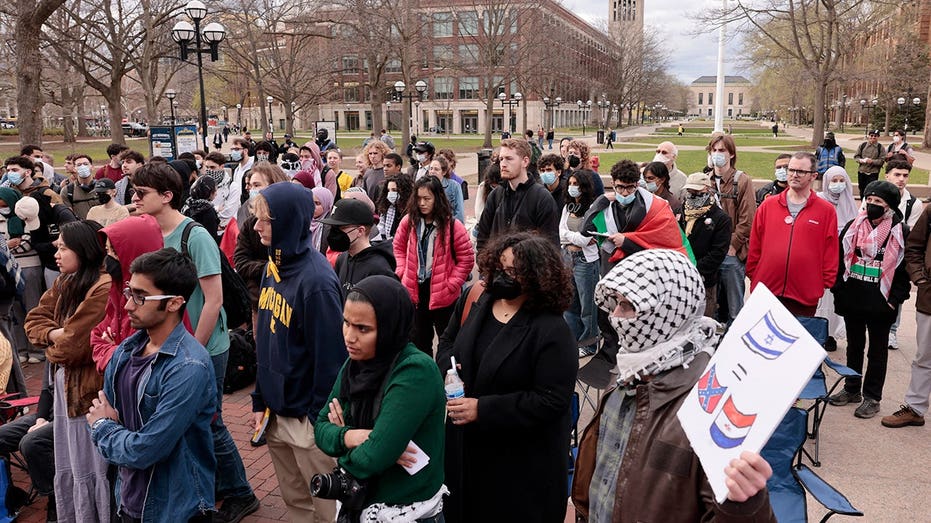
This case did not unfold in isolation. Since the Hamas terror attacks of October 7, 2023, university campuses across America have experienced intense protests, encampments, and demonstrations over U.S. and institutional policy toward Israel.
Universities including Columbia University, UCLA, and the University of Texas have all seen high-profile clashes involving pro-Israel and pro-Palestinian activists. Some schools have struggled to balance student activism with safety concerns.
The University of Michigan itself has experienced repeated protests urging divestment from companies with ties to Israel. The Board of Regents declined to adopt such measures, citing fiduciary obligations and institutional neutrality.
That refusal appears, according to prosecutors, to have fueled escalating tactics among some activists.
Free Speech Versus Criminal Conduct
One of the most consequential elements of this case will be drawing a clear legal line between constitutionally protected protest and criminal intimidation.
Under U.S. law, political advocacy—even harsh or offensive criticism—is protected. However, direct threats, property destruction, stalking, and attempts to terrorize individuals fall outside First Amendment protections.
The Supreme Court has consistently ruled that “true threats” are not shielded by free speech doctrine. If prosecutors can prove that the defendants crossed that line, convictions could follow despite the political nature of the speech.
At the same time, defense attorneys are expected to argue that inflammatory rhetoric and online discussions do not necessarily equate to actionable, imminent threats.
Impact on Jewish Communities and University Leaders
The targeting of homes and Jewish-affiliated properties has raised concerns among Jewish students and faculty who say such actions create fear and hostility.
The Anti-Defamation League has reported a significant spike in antisemitic incidents nationwide since October 2023. While peaceful protest remains legal, vandalism and intimidation tied to religious identity or national origin can potentially implicate federal civil rights statutes.
Regent Sarah Hubbard expressed gratitude toward law enforcement following the filing of charges, according to public reporting, signaling the emotional toll such incidents can take on public officials and their families.
University officials have a duty to maintain both free expression and physical safety—a mission that becomes especially difficult when activism escalates into alleged criminal conduct.
Why This Case Matters Nationally
This prosecution could set an important precedent for how federal authorities handle politically motivated threat campaigns that originate on campus but affect private homes and communities.
It also signals an unmistakable message: while Americans have the right to protest government policy or international affairs, coordinated intimidation campaigns that target families and private residences may trigger serious legal consequences.
Across the country, policymakers are debating how to address campus unrest without infringing on constitutional liberties. The Department of Justice’s approach in this case may serve as a roadmap for future prosecutions involving extremist tactics cloaked in political activism.
What Comes Next
For now, the four defendants remain free under strict supervision as federal prosecutors continue building their case. Additional hearings will determine whether others named in the indictment remain detained or are granted similar bond conditions.
The government must still prove its case beyond a reasonable doubt. The defendants are presumed innocent until proven guilty in a court of law.
But the broader implications are already clear. As tensions over U.S.-Israel policy continue to fuel heated debate nationwide, Americans are again confronted with a fundamental question: where does protected protest end—and prosecutable threat begin?
In a nation built on liberty, the answer must preserve both security and constitutional rights. Courts, not mobs, will decide whether the conduct alleged in this case was activism—or criminal conspiracy.
Wake Up America will continue to follow developments in the Eastern District of Michigan and report on how this case shapes the national conversation about campus activism, political intimidation, and the rule of law.