U.S. Forces Strike Narco-Terror Vessel in Eastern Pacific, Eliminating Suspected Trafficker
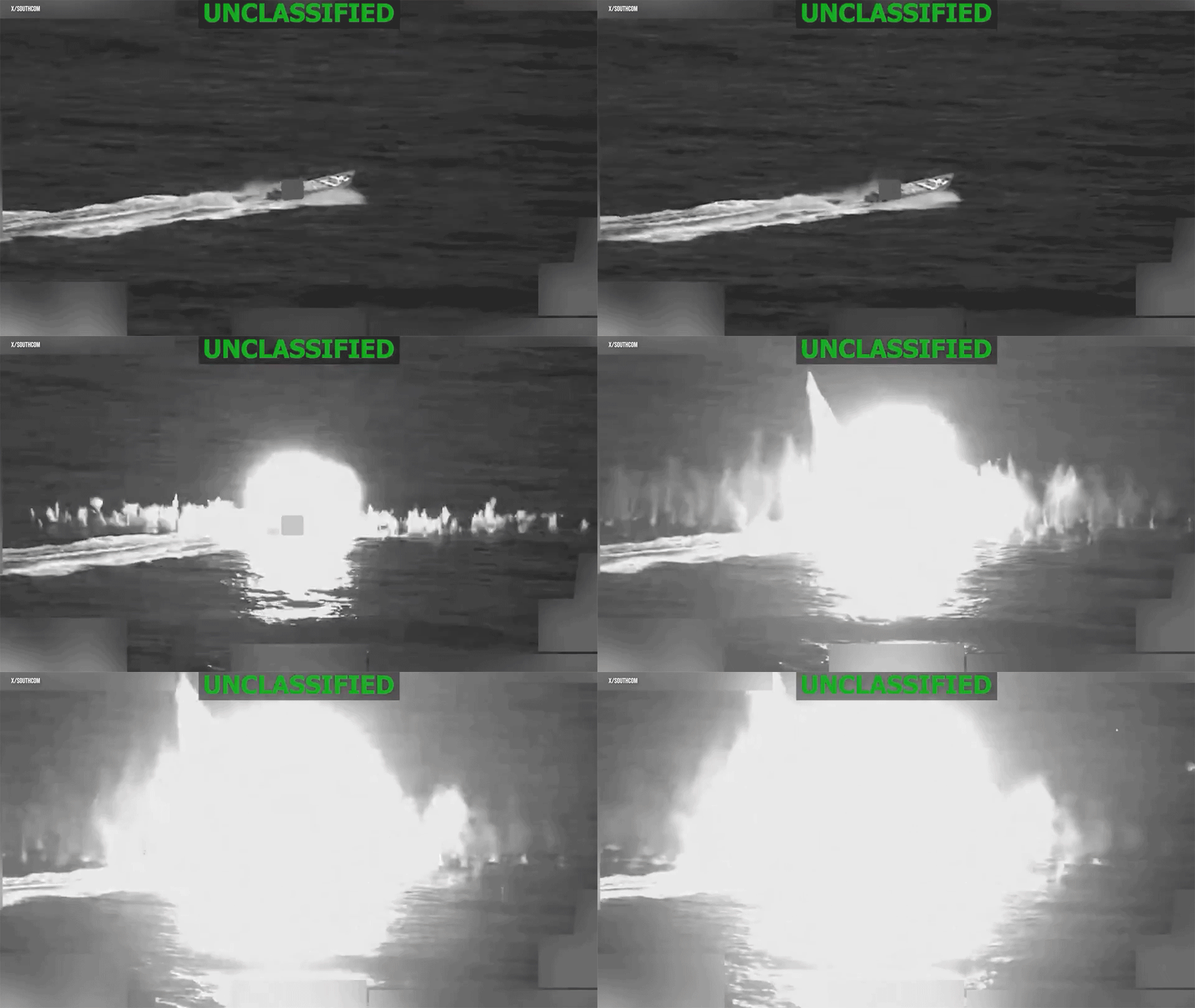
The United States military delivered another decisive blow against international drug-trafficking networks this week, carrying out a lethal strike on a suspected narco-terrorist vessel operating in the Eastern Pacific. The operation, directed by U.S. Southern Command (SOUTHCOM), resulted in the death of one alleged narco-terrorist, while two others survived and were reportedly left in the water following the engagement.
According to SOUTHCOM, the strike took place on May 26 under the authority of Gen. Francis L. Donovan, the commander of the combatant command responsible for U.S. military operations throughout Latin America and the Caribbean. The operation was executed by Joint Task Force Southern Spear, a U.S. military element tasked with targeting transnational criminal and terrorist threats in the region.
No American service members were injured during the strike, underscoring both the precision of modern U.S. military capabilities and the professionalism of the forces involved.
A Target Moving Along Known Drug Corridors
U.S. officials stated that intelligence surveillance had confirmed the vessel was operating along established narco-trafficking routes in the Eastern Pacific—waters long known to serve as primary highways for illicit narcotics bound for North America.
The Eastern Pacific and Caribbean Sea regions are critical transit corridors for drug shipments originating in South America. According to the Drug Enforcement Administration (DEA), a significant percentage of cocaine destined for the United States passes through maritime routes in these waters before reaching Central America or Mexico for further transport.
Cartels typically rely on:
- Low-profile “go-fast” boats capable of high speeds.
- Semi-submersible and fully submersible vessels designed to evade radar.
- Fishing boats and commercial vessels used as cover for trafficking operations.
Intelligence assessments reportedly determined that this particular vessel was actively engaged in narcotics trafficking and linked to organizations designated as terrorist entities. While SOUTHCOM has not publicly named the group involved, the U.S. government has in recent years labeled certain cartel networks as terrorist organizations due to their paramilitary capabilities and destabilizing activities.
Coordination with the U.S. Coast Guard
Immediately following the strike, SOUTHCOM notified the U.S. Coast Guard, which initiated search-and-rescue operations to recover the surviving suspects.
This coordination reflects the longstanding partnership between the Department of Defense and the Coast Guard in maritime counter-drug missions. The Coast Guard, operating under the Department of Homeland Security in peacetime, maintains robust authority to conduct law enforcement actions on the high seas under international maritime law.
The Coast Guard’s role is critical in ensuring that surviving suspects are detained, medically treated if necessary, and transferred for prosecution under U.S. law. American courts have jurisdiction over significant narcotics trafficking operations conducted on stateless vessels in international waters.
A Pattern of Escalating Counter-Narcotics Strikes
The May 26 strike is far from an isolated action. It is part of a sustained campaign aimed at dismantling drug-smuggling pipelines that ultimately feed American cities with deadly narcotics.
Earlier in May, U.S. forces carried out a similar strike in the Eastern Pacific that killed two suspected narco-terrorists and left one survivor. Days before that, another operation in the Caribbean resulted in the deaths of two additional suspected traffickers.
These operations are authorized within the broader framework of U.S. counter-drug strategy and are conducted under rules of engagement designed to protect American forces while disrupting cartel logistics.
SOUTHCOM, one of the U.S. military’s regional unified combatant commands, oversees security cooperation and contingency planning across 31 countries and 16 dependencies in Central and South America and the Caribbean. You can learn more about its mission at the official SOUTHCOM About page.
Why the Eastern Pacific Matters
The Eastern Pacific has become a focal point in America’s war against narcotics trafficking. Its vast maritime expanse provides traffickers with concealment, while its proximity to Central America and Mexico makes it a strategic funnel toward the U.S. southern border.
The United Nations Office on Drugs and Crime, through its UNODC global monitoring programs, has repeatedly identified maritime trafficking as a principal vector for cocaine distribution.
After narcotics are shipped northward via sea routes, cartels rely on established smuggling corridors through Central America—especially through countries like Guatemala and Honduras—before the drugs are transported across Mexico and into the United States.
By targeting vessels in the Eastern Pacific before they can reach transfer points, U.S. forces are effectively engaging traffickers at the source of transit rather than waiting until the drugs reach land.
Narco-Terrorism and National Security
The term “narco-terrorist” is not used lightly. It reflects the increasing convergence between organized crime and ideologically driven violence. Some trafficking networks employ military-grade weapons, armored vehicles, encrypted communications, and even drones to protect their operations.
The U.S. Department of State, through its Foreign Terrorist Organizations designation process, has the authority to classify certain groups whose activities threaten American national security.
When drug cartels evolve beyond mere criminal enterprises and begin wielding influence that destabilizes governments, finances insurgencies, or threatens border security, they cross the line into a category that warrants a national defense response.
America’s approach in the Eastern Pacific recognizes that narcotics trafficking is not just a public health crisis—it is also a strategic threat. Drug profits fuel corruption, fund violence, and undermine democratic institutions across the Western Hemisphere.
Protecting the Homeland Before the Border
Stopping narcotics at sea has clear national security advantages. It prevents deadly substances such as cocaine and fentanyl precursors from ever reaching U.S. soil.
According to the U.S. Customs and Border Protection (CBP), record quantities of illegal drugs continue to be seized at America’s borders each year. But seizures at the border are only part of the equation. Interdictions at sea reduce the burden on border enforcement agencies and weaken cartel supply chains upstream.
When military assets disrupt a shipment in international waters, traffickers lose:
- The narcotics payload itself.
- The vessel and equipment used.
- Experienced operatives.
- Financial investments tied to a single operation.
These losses multiply over time, particularly when high-level organizers realize that U.S. forces are willing and capable of striking before shipments reach staging areas closer to American shores.
Rules, Law, and Accountability
Some may ask what legal framework allows the U.S. military to conduct lethal strikes on suspected traffickers in international waters. The answer lies in longstanding authorities granted by Congress and international maritime law.
The U.S. Code Title 10 governs the role of the armed forces, while counter-drug missions are supported by provisions enabling the Department of Defense to assist law enforcement agencies in combating transnational crime.
Additionally, stateless vessels operating on the high seas do not enjoy the protection of any national flag. If they are engaged in illicit activities such as drug trafficking, they may be interdicted under internationally recognized principles.
Officials have emphasized that each operation undergoes legal review and strict adherence to rules of engagement. The safety of American personnel remains paramount, and force is used only when necessary.
Strategic Message to Cartels
Beyond tactical interdiction, operations like this send a strategic signal. They reinforce that the United States will not tolerate maritime highways being used as pipelines of destruction aimed at American communities.
Gen. Donovan’s directive for Joint Task Force Southern Spear to execute the strike demonstrates the administration’s willingness to apply hard power against networks undermining U.S. sovereignty and public safety.
By maintaining persistent surveillance and readiness in the region, SOUTHCOM increases uncertainty for trafficking organizations. Cartel planners must now factor in the real possibility that any voyage across known narcotics corridors could end in immediate interdiction—or worse.
The Broader Hemispheric Fight
Counter-narcotics operations in the Eastern Pacific are part of a larger hemispheric effort. The United States works alongside partner nations in Central and South America to strengthen maritime patrol capabilities, enhance intelligence sharing, and build law enforcement capacity.
Security cooperation initiatives often include training exercises, equipment transfers, and coordinated maritime patrols. These joint efforts aim to ensure that trafficking networks cannot simply reroute around U.S. patrol zones.
The battle is not merely about drugs—it is about restoring rule of law in regions where cartels wield disproportionate influence through corruption and intimidation.
No American Casualties Reported
Notably, SOUTHCOM confirmed that no U.S. service members were injured during the strike. This outcome reflects advancements in intelligence, surveillance, and reconnaissance capabilities, as well as disciplined execution by American forces.
Every mission carries risk, especially in open-ocean environments where weather, visibility, and intelligence variables can shift rapidly. The safe return of U.S. personnel underscores the professionalism of those tasked with these dangerous assignments.
America’s Resolve in the Fight Against Narco-Terror
The lethal strike in the Eastern Pacific marks another chapter in a campaign aimed at confronting a crisis that has taken a devastating toll across the United States. Drug overdose deaths, fueled by sophisticated smuggling networks, have ravaged families from coast to coast.
While rehabilitation, prevention, and border security are all essential components of a comprehensive response, maritime interdiction targets the logistical backbone of international trafficking. By cutting off shipments at sea, American forces are pushing the fight outward—away from U.S. communities and toward the criminal networks that profit from addiction and violence.
As long as cartels attempt to exploit international waters as safe passage, U.S. forces operating under SOUTHCOM’s command appear prepared to meet that threat head-on.
The message is clear: America will defend its security interests, safeguard its borders, and disrupt organizations that poison its citizens—whether on land or at sea.
Wake Up America News – Your Source for Patriotic News.