DOJ Lawsuit Alleges Jewish Students Faced Violence and Exclusion During UCLA Anti-Israel Encampment
The U.S. Department of Justice has filed a sweeping federal lawsuit accusing the University of California system and the University of California, Los Angeles (UCLA) of allowing what it describes as a hostile and dangerous environment for Jewish and Israeli students during the height of anti-Israel campus unrest in 2024.
According to the complaint filed in the U.S. District Court for the Central District of California, Jewish students were beaten with sticks and blunt objects, pepper sprayed, shoved to the ground, kicked, slapped, and in at least one case knocked unconscious and hospitalized with a head wound.
The lawsuit asserts that university leaders failed to act decisively for months while antisemitic rhetoric escalated into what the Department of Justice characterizes as targeted violence and unlawful discrimination in violation of federal civil rights law.
A Breakdown of the Allegations
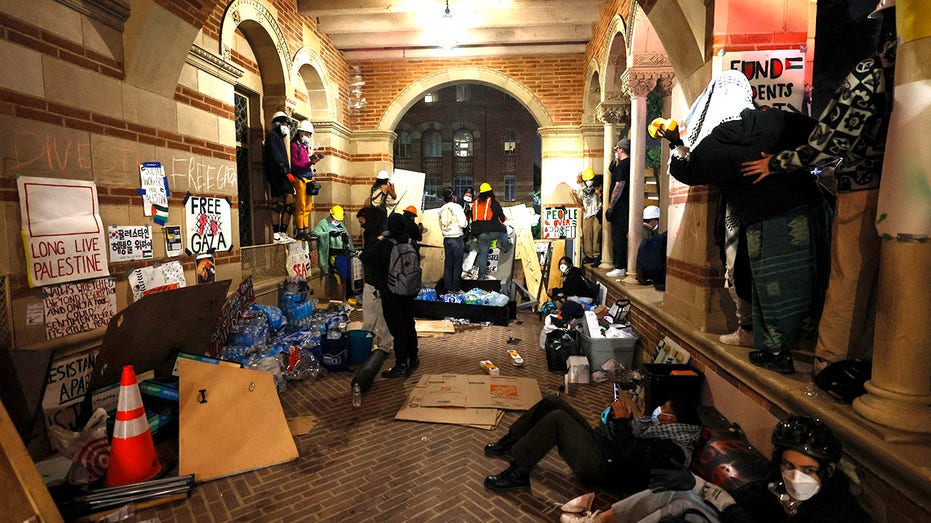
The lawsuit centers on events that erupted on April 25, 2024, after months of anti-Israel protests. Demonstrators allegedly erected an encampment in Royce Quad, a central and heavily traveled section of campus near Royce Hall and Powell Library.
According to federal prosecutors, protesters constructed barricades using plywood, metal bike racks, garbage cans, tents, and ropes. These makeshift structures allegedly restricted access to academic buildings and created what the DOJ describes as de facto “exclusion zones.”
- Jewish and Israeli students reportedly blocked from campus pathways and libraries
- “Human chains” formed to prevent certain students from passing through the quad
- Wristbands distributed to those permitted entry — excluding Jewish and Israeli individuals
- Graffiti and signage featuring explicit antisemitic language
The complaint claims that protesters armed themselves with pepper spray and wooden boards. In addition, demonstrators allegedly established what prosecutors described as “militia-style checkpoints” in which individuals were denied passage unless they renounced core elements of their religious or national identity.
Such conduct, if proven, would directly implicate Title VI of the Civil Rights Act of 1964, which prohibits discrimination on the basis of race, color, or national origin in programs receiving federal funding.
Specific Acts of Alleged Violence
The complaint details a series of violent incidents that federal officials argue demonstrate more than political protest — they argue it showed patterns of intimidation directed at identifiable students.
Among the examples:
- A Jewish student reportedly beaten unconscious, suffering an open head wound and requiring hospitalization
- A woman wearing a Star of David necklace allegedly pepper sprayed while holding an Israeli flag
- A Jewish man physically assaulted and told, “Hitler missed one”
- A Native American Jewish woman counter-protesting allegedly surrounded and violently attacked
According to the filing, campus police officers were positioned nearby during at least one of these incidents but allegedly failed to intervene. The DOJ contends that this inaction contributed to an atmosphere where antisemitic conduct went unchecked.
The Role of Student Groups and Faculty
The encampment was reportedly organized by a coalition calling itself UC Divest, which includes the controversial group Students for Justice in Palestine (SJP). The lawsuit alleges that certain faculty members not only supported the encampment but assisted demonstrators in maintaining it.
Federal officials assert that protesters barricaded portions of Royce Hall and Powell Library and openly displayed signs containing vulgar messages attacking Israel and Jewish individuals.
On April 30, 2024, UCLA administrators declared the encampment illegal and ordered participants to disperse or face discipline. The university’s chancellor at the time acknowledged that Jewish students were in a “state of anxiety and fear” and that students had been physically blocked from accessing academic buildings.
However, the DOJ argues that these steps came too late, after violence and intimidation had already escalated.
Clashes Escalate
As tensions intensified, counter-protesters engaged members of the encampment in chaotic confrontations. According to the complaint, both sides allegedly использished pepper spray, blunt objects, and even fireworks during altercations.
The unrest continued into May and June 2024, creating what federal officials describe as prolonged instability on campus.
In another incident cited in the lawsuit, a van arrived on campus bearing antisemitic imagery, including a Star of David inside a swastika and language referring to Jews as “puppet masters.” The vehicle was reportedly welcomed by individuals supporting the encampment.
The DOJ argues that these acts evidenced not mere foreign policy activism but explicit hostility toward Jewish individuals as a protected group.
Survey Data Highlights Impact
Following the unrest, 428 Jewish and Israeli students, faculty members, and staff were surveyed about their experiences. Roughly half reported witnessing physical threats or direct attacks aimed at Jews or Israelis.
One respondent stated that he had been blocked from entering areas of campus because he was Jewish and that demonstrators collectively called for an “intifada,” a term historically associated with violent uprisings against Israel.
The cumulative impact, prosecutors argue, amounted to systemic discrimination rather than isolated conflicts.
The Legal Foundation: Title VI
The lawsuit rests squarely on Title VI protections. Institutions that receive federal funding — including public universities — are legally required to ensure that students are not subjected to discrimination based on race or national origin.
Failure to prevent a hostile environment can expose a university to enforcement actions by the Department of Justice Civil Rights Division, including court-ordered reforms or loss of federal funding.
Assistant Attorney General Harmeet K. Dhillon stated that the government intends to hold UCLA accountable for what she described as the “toleration” of a discriminatory campus environment.
First Assistant U.S. Attorney Bill Essayli for the Central District of California echoed that sentiment, emphasizing that universities must protect all students equally under the law.
University Leadership Responds
University of California President James Milliken responded to the lawsuit by reaffirming that antisemitism has no place within the UC system.
University leadership maintains that it has implemented systemwide reforms and initiatives designed to improve campus safety and address antisemitism.
UCLA Chancellor Julio Frenk — whose family history includes persecution during the Holocaust — has reportedly made protecting Jewish students a priority since taking office. UC officials argue that federal litigation fails to acknowledge corrective actions already underway.
The university also contends that broader federal scrutiny of campus policies may complicate rather than assist ongoing reform efforts.
Broader Context: A National Campus Crisis
The events at UCLA must be understood within the context of widespread campus unrest following Hamas’ October 7, 2023, terrorist attack on Israel. That attack, carried out by the U.S.-designated terrorist organization Hamas, triggered months of heated demonstrations at universities nationwide.
Institutions from Columbia University to Harvard faced scrutiny over their handling of antisemitic incidents.
Across the country, critics argue that university administrators sometimes prioritized managing public relations fallout over swiftly enforcing campus rules and civil rights protections.
The UCLA case now stands as one of the most significant federal legal challenges to arise from that wave of unrest.
Financial and Institutional Costs
Beyond the human toll, the unrest reportedly caused $12.3 million in property damage at the taxpayer-funded university.
For many Americans, the financial impact amplifies concerns that public institutions entrusted with education strayed from their core mission.
Taxpayers, students, and parents alike are now watching closely to see whether federal enforcement will fundamentally reshape how universities respond to politically charged demonstrations — especially when protests cross the line into alleged discrimination or violence.
The Bigger Picture: Free Speech vs. Civil Rights
At the heart of this lawsuit is a delicate but essential constitutional balance.
Universities serve as hubs for open debate, protected by the First Amendment. However, free speech does not protect assault, physical obstruction, or discriminatory exclusion.
Federal courts will ultimately weigh whether UCLA’s actions — or alleged inaction — constituted a violation of civil rights law rather than a permissible handling of protected protest activity.
The outcome could set an important precedent for public universities nationwide.
Accountability and the Future of Campus Safety
The Department of Justice lawsuit represents more than a legal filing. It signals a broader message: public universities cannot allow political movements, no matter how passionately held, to infringe upon the safety and civil rights of American students.
If the allegations are substantiated, the case may compel UCLA to implement stricter enforcement mechanisms, enhanced policing protocols, and more decisive disciplinary measures against those who cross the boundary between speech and violence.
For Jewish and Israeli students who reported fear and isolation during the encampment, the lawsuit is seen as a long-overdue federal response.
For university leaders across America, it is a warning that tolerating antisemitic conduct — whether through action or inaction — may carry serious legal consequences.
In a nation built on equal protection under law, civil rights protections are not optional. They apply to every student on every campus. That principle, enshrined in the Civil Rights Act of 1964, remains as vital today as it was more than six decades ago.
The coming months will determine whether the federal courts agree that UCLA failed to uphold that standard — and whether this case marks a turning point in restoring order, accountability, and fairness to America’s institutions of higher learning.
Wake Up America News — Your Source for Patriotic News.