Violent Attack at California’s “Trump House” Raises Alarming Questions About Political Hostility and Mental Health Failures
A shocking act of violence in Escondido, California has left a 69-year-old homeowner fighting for his life and reignited concerns about political intolerance and public safety in America’s increasingly divided culture.
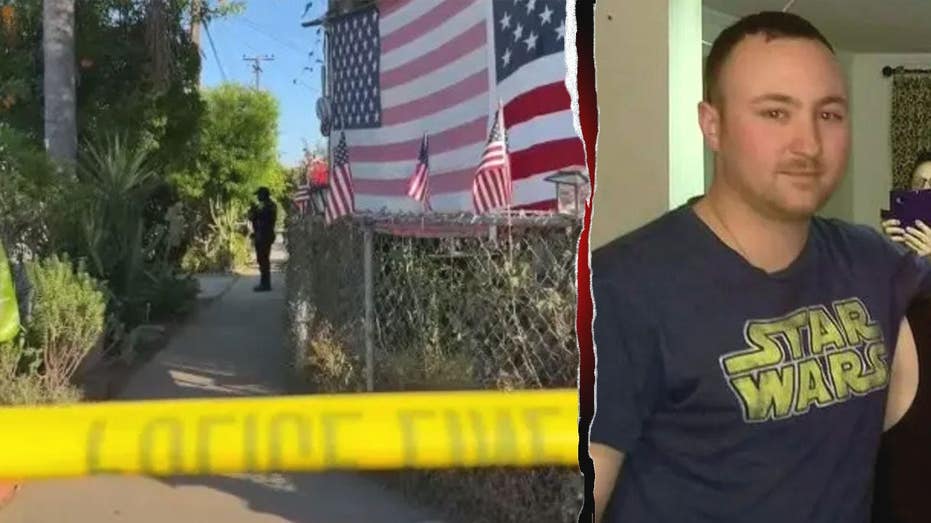
Authorities have charged 32-year-old Thomas Caleb Butler, a U.S. Navy veteran reportedly suffering from serious mental illness, with attempted murder after he allegedly attacked Kerry Sheron — the owner of the well-known “Trump House.” The home, a prominent display of American flags and pro-Trump signage, has long stood as a symbol of unapologetic patriotism in a deeply blue region of Southern California.
As Sheron remains in intensive care, his wife says she does not expect him to survive his injuries. The case has quickly drawn national attention, raising difficult questions not only about political violence but about how America cares for its veterans and handles mental health crises.
The Attack: What Happened in Escondido
According to the Escondido Police Department, officers responded around 2:15 p.m. Wednesday to reports of an assault at the intersection of East Mission Avenue and Buchanan Street — directly adjacent to the home widely known in the area as the “Trump House.”
When officers arrived, they found Kerry Sheron suffering from what authorities described as “significant injuries.” A bystander who reportedly attempted to intervene during the attack was also injured.
Sheron was transported to a local hospital, where he remains in intensive care. His wife, Maria Garcia, has publicly shared her deep anguish, telling local media she does not believe her husband will survive.
“He tried to kill my husband,” Garcia said. “It’s terrible… I don’t know what kind of hate — what kind of heart.”
Police say Butler fled the scene but was apprehended a short time later. He is currently being held without bail at the Vista Detention Facility, operated by the San Diego County Sheriff’s Office. He faces a charge of attempted murder.
The “Trump House”: A Symbol of Patriotism — and Controversy
For years, Sheron’s home has been covered in American flags, patriotic banners, and pro-Trump displays. In a region dominated by left-leaning politics, the property became a recognizable landmark — and, at times, a lightning rod.
Neighbors have occasionally complained about the visual display, and the house has reportedly been vandalized before. Still, Sheron remained firm in his convictions.
His wife made it clear that the couple’s intention was never to provoke but to celebrate what they believe in — love of country, support for President Donald J. Trump, and pride in America’s flag.
“They don’t like the flags,” Garcia said. “I don’t know why. I support America. My husband is a veteran.”
In the United States, the right to political expression — including displaying flags and signage — is protected under the First Amendment to the U.S. Constitution. While neighbors may disagree, peaceful political expression is a foundational American liberty.
The question now haunting many observers is whether this violent incident was fueled, at least in part, by political animus.
The Suspect: A Navy Veteran Battling Mental Illness
Thomas Caleb Butler, 32, is described by acquaintances as a former member of the United States Navy who has struggled with severe mental health challenges since leaving military service.
A friend told reporters that Butler had been prescribed medication for mental illness but that the treatment appeared to be failing. According to the friend, Butler had become increasingly isolated, unemployed, and paranoid following his time in the military.
“He sits in his room and thinks everyone is coming to get him,” the friend reportedly said, describing behavior consistent with severe psychological distress.
America has long wrestled with how to properly support returning service members who suffer from post-traumatic stress disorder (PTSD), traumatic brain injury, depression, and other mental health conditions. The U.S. Department of Veterans Affairs provides services and treatment to millions of veterans, yet gaps in care, long wait times, and bureaucratic hurdles have been recurring concerns raised by lawmakers over the years.
According to the National Center for PTSD, PTSD can significantly impair judgment, emotional regulation, and social functioning when untreated or poorly managed. However, it is also critical to note that the overwhelming majority of veterans — including those diagnosed with PTSD — do not engage in violent behavior.
The intersection of mental illness and criminal violence is complex. Experts emphasize that untreated psychosis, severe paranoia, or substance abuse can sometimes amplify risks, particularly if an individual becomes detached from reality.
In this case, investigators have not publicly concluded whether mental illness, political motives, or a combination of factors played a role.
Was the Attack Politically Motivated?
Maria Garcia believes the assault was driven by hostility toward the political messaging displayed outside her home.
“They don’t like the flags,” she insisted in interviews. To her, the attack is not random — it is symbolic.
While authorities have not officially labeled the incident a hate crime or politically motivated assault, the context has fueled strong reaction from conservative leaders.
Representative Darrell Issa (R-Calif.) issued a public call for a “full and immediate investigation,” arguing that supporters of President Trump are increasingly subjected to violence and intimidation.
Political polarization in America has intensified over the past decade. According to research from institutions such as the Pew Research Center, ideological divisions between conservatives and liberals are sharper now than at almost any time in modern history. Heated rhetoric on social media, partisan media ecosystems, and public protests have contributed to a climate where dialogue often gives way to hostility.
While political disagreement is a cornerstone of democratic republics, physical violence over ideological beliefs crosses a dangerous line.
Free Speech, Property Rights, and Public Safety
The case also highlights broader national debates about free expression and tolerance.
Displaying political signs on private property is not merely a custom — it is a constitutionally protected right. The American Civil Liberties Union has consistently affirmed that offensive or controversial speech is still protected speech, absent direct incitement to violence.
America’s founders understood that robust debate — even passionate disagreement — is healthier than suppression. The solution to speech one dislikes, as the saying goes, is more speech, not violence.
When attacks occur over political displays, they send a chilling message that some viewpoints are unwelcome not just socially, but physically. This undermines the marketplace of ideas at the heart of constitutional governance.
Mental Health System Under Scrutiny
At the same time, this tragedy also underscores serious shortcomings in America’s mental health system.
According to the National Institute of Mental Health, millions of Americans live with serious mental illness. Many struggle to access continuous, effective treatment. Veterans face unique challenges adjusting to civilian life, particularly those exposed to combat stress.
Several persistent issues complicate mental health intervention:
- Stigma surrounding psychiatric treatment, especially among veterans.
- Inconsistent medication adherence.
- Limited crisis-intervention resources.
- Difficulties balancing civil liberties with involuntary commitment laws.
When individuals deteriorate psychologically, family and friends often find themselves powerless under current legal standards unless there is an immediate and provable threat. Policymakers across the political spectrum have debated reforms aimed at early intervention while preserving constitutional protections.
This case may once again fuel that discussion.
A Community Waiting for Answers
As Kerry Sheron clings to life, neighbors in Escondido are grappling with shock. Whatever their political leanings, many recognize that an elderly man being beaten outside his own home is deeply troubling.
The injured bystander who tried to intervene also serves as a reminder that courage still exists — that ordinary Americans often step forward when they see wrongdoing.
Law enforcement will now conduct a detailed investigation, gathering evidence, examining potential motives, and determining whether additional charges are warranted. Butler remains in custody without bail, signaling that the court considers him a serious flight or danger risk while proceedings unfold.
The Bigger Picture: Civility and the Future of American Politics
This violent episode is more than a local crime story. It reflects a nation facing heightened political tension, mental health challenges, and deep distrust between neighbors.
America is strongest when disagreements are settled at the ballot box, in public debate, and through lawful civic engagement — not through fists or weapons.
The promise of this country is that citizens can advocate for President Trump, President Biden, or any lawful political cause without fear of physical reprisal. That principle must remain untouchable.
If the allegations are proven true, then justice must be served swiftly and fairly. But beyond the courtroom, broader conversations are unavoidable:
- How do we reduce political dehumanization?
- How do we better care for veterans facing mental health crises?
- How do communities protect constitutional freedoms while maintaining peace?
None of these questions have simple answers. Yet ignoring them invites further tragedy.
For now, a wife sits by her husband’s bedside in a hospital ICU, preparing for the possibility of loss. A veteran sits in a jail cell awaiting trial. And a community is reminded of how fragile civility can be when political anger and untreated illness collide.
Wake Up America News will continue to monitor developments in this case closely. Justice, accountability, and the defense of constitutional freedoms remain essential pillars of a strong republic — and Americans of all political stripes should demand nothing less.
Your Source for Patriotic News.