Oregon Officer Shot, Multiple Lives Lost in Sandy Standoff as Community Reels from Tragedy
A quiet Sunday afternoon in the small city of Sandy, Oregon, was shattered by gunfire when law enforcement officers responding to a reported domestic disturbance found themselves in the middle of a deadly and fast-moving crisis. One police officer was shot multiple times, and several individuals inside a residence were killed before the suspect ultimately surrendered after a tense hours-long standoff.
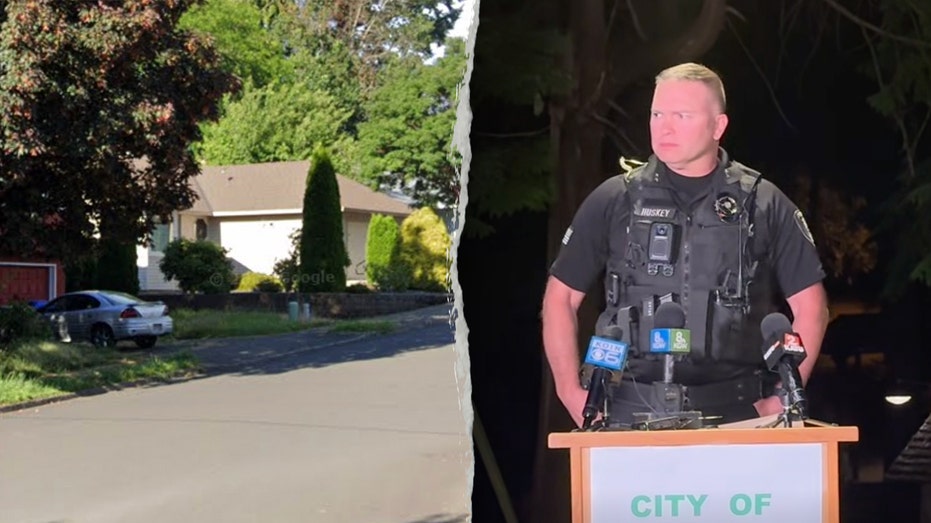
The incident unfolded in the 39000 block of Evans Street in Sandy, a close-knit community of roughly 12,000 residents located about 30 miles east of Portland near the foothills of Mount Hood. What began as a domestic disturbance call escalated into one of the most serious law enforcement incidents the city has seen in years.
Emergency Response to a Domestic Disturbance
Shortly before 4 p.m., officers with the Sandy Police Department and deputies from the Clackamas County Sheriff’s Office responded to reports of a domestic situation involving gunfire. Domestic disturbance calls are among the most volatile and unpredictable scenarios officers face.
As law enforcement units arrived at the residence, gunfire erupted. Officers immediately returned fire in an effort to defend themselves and stabilize the scene.
During the exchange, one Sandy police officer was struck multiple times. The wounded officer was airlifted to a nearby trauma center by Life Flight. Authorities later confirmed the officer was in stable condition and expected to survive.
“The officer is in stable condition, and I’m extremely thankful that I can tell you that they are expected to survive,” said Sandy Police Chief Patrick Huskey during a press briefing. “There are multiple victims deceased at this time.”
The chief’s statement confirmed what many in the community feared: the violence inside the home had already claimed multiple lives before police could end the threat.
A Barricaded Suspect and a Locked-Down Neighborhood
After the initial exchange of gunfire, the suspect barricaded himself inside the residence. The situation quickly escalated into a major multi-agency response.
Nearby residents were placed under a shelter-in-place order as law enforcement secured the perimeter. Tactical teams, negotiators, and medical units converged on the neighborhood. For several hours, the normally calm suburban street was transformed into a high-risk containment zone.
Authorities have not publicly disclosed the specific weapons used during the incident, nor have they revealed the identities of those killed. The deaths are being investigated as homicides.
Eventually, just before 8 p.m., the suspect surrendered and was taken into custody without further injury. Law enforcement officials later lifted the shelter-in-place order and confirmed that there was no ongoing threat to the public.
Multiple Agencies Step In
Given the scope of the incident, additional law enforcement resources were deployed. The Multnomah County Sheriff’s Office announced that it was assisting and helping investigate the deadly events.
In a public statement, the agency said:
“Our thoughts are with the recovering officer, the homicide victims, their families, and the entire Sandy community. We are also thinking of the first responders who faced significant danger on Sunday.”
Coordinated responses of this scale often involve mutual aid agreements among police departments and sheriff’s offices throughout the region. In high-risk armed barricade situations, specialized tactical response units and crisis negotiators are frequently deployed to prevent further loss of life.
Investigators are now working to piece together a timeline of events, which will likely involve forensic processing of the crime scene, ballistic testing, witness interviews, and a detailed review of 911 call recordings.
“An Unimaginable Loss of Lives”
Sandy Mayor Kathleen Walker described the incident as an “unimaginable loss of lives” and acknowledged the deep emotional toll the violence has taken on the community.
“This tragedy reaches beyond the neighborhood where it happened,” she said. “It reaches the families and friends of the victims, and the neighbors who witnessed the shootings and aftermath.”
The mayor also expressed gratitude for the officers who responded, especially the wounded officer who put his or her life on the line to protect others.
“We honor our city police officers who answered the call, and the officer that was wounded. It shakes our community to its core.”
In a small city like Sandy, such events are not just news headlines — they are deeply personal. The victims may be friends, relatives, classmates, coworkers, or neighbors. The trauma ripples outward in ways that statistics can never fully capture.
The Danger of Domestic Violence Calls
According to law enforcement professionals nationwide, domestic disturbance calls are among the most dangerous and unpredictable for officers. Emotions run high. The parties involved may be armed. And officers often arrive with limited information.
The National Institute of Justice, part of the U.S. Department of Justice, has long studied the risks law enforcement officers face during domestic incidents. Research consistently shows that disputes inside private homes — particularly when firearms are present — can quickly escalate into deadly encounters.
These calls require officers to balance several competing priorities:
- Protecting potential victims inside the residence
- De-escalating the suspect when possible
- Maintaining situational awareness in confined spaces
- Preventing harm to neighbors and bystanders
When shots are fired as officers arrive, the situation instantly shifts from crisis response to life-or-death defense.
Community Safety and Shelter-in-Place Orders
During the lengthy standoff, law enforcement issued shelter-in-place orders for nearby residents — a standard precaution during active armed barricade incidents.
This measure is intended to:
- Keep residents safely indoors
- Prevent bystander injuries
- Allow officers to focus on containment without civilian interference
- Reduce the risk of a suspect fleeing into nearby homes or yards
Such orders can be unsettling for families caught inside their homes without clear details about what is unfolding outside. Yet they are a critical tool for protecting the public.
After the suspect surrendered, authorities moved quickly to lift restrictions and reassure residents that the area had been secured.
Law Enforcement Under Fire
The shooting in Sandy is a sobering reminder of the daily risks American law enforcement officers accept when they put on the badge.
Across the country, officers respond to millions of calls each year — from traffic accidents and noise complaints to violent felonies in progress. While most interactions resolve peacefully, it only takes one volatile situation to turn deadly.
According to data compiled by the FBI’s Uniform Crime Reporting Program, assaults against law enforcement officers and firearm-related threats remain persistent challenges nationwide. Officers operating in rapidly evolving situations have seconds to make split-second decisions.
The officer wounded in Sandy survived, but the outcome could have been far worse. The fact that he or she is expected to recover is a blessing in the midst of profound tragedy.
The Broader Impact on a Small American Town
Sandy sits along U.S. Route 26, serving as a gateway to the Mount Hood recreation area. Known for its community spirit and family-friendly neighborhoods, the city has long been considered a safe place to live and raise children.
Violence of this magnitude shakes that sense of security.
Residents now face difficult questions:
- What led to such an extreme escalation inside the home?
- Were there prior warning signs?
- How can similar tragedies be prevented?
While investigators continue their work, local leaders are urging unity and support for the victims’ families.
The Investigative Process Ahead
Homicide investigations of this scale are meticulous and time-consuming. Authorities will need to determine:
- The precise sequence of events leading to the shootings
- The relationship between the suspect and the victims
- Whether prior domestic disturbances had been reported
- How the suspect obtained the weapon or weapons used
Investigators will also review body camera footage, if available, as well as communications between dispatch and responding officers. Transparency in such cases is critical to maintaining public trust.
For now, officials have been careful not to release details that could compromise the integrity of the ongoing investigation.
A Time for Prayer and Support
In the wake of tragedy, small communities often rally around those most affected. Churches, civic groups, and local businesses frequently organize fundraising efforts, memorial services, and counseling support for grieving families.
The emotional toll extends beyond the victims’ loved ones. First responders — including officers, paramedics, and dispatchers — carry the weight of what they witnessed.
Law enforcement agencies today increasingly recognize the importance of peer support and mental health resources for officers who endure traumatic experiences on duty. Events like this leave lasting impressions long after the flashing lights fade.
Standing Behind Law Enforcement and the Rule of Law
At its core, this tragedy underscores a fundamental truth: maintaining law and order requires men and women willing to step into danger so others don’t have to.
The wounded officer in Sandy answered a call for help — knowing that domestic violence situations are unpredictable and potentially deadly. That courage embodies the best of American public service.
As the community mourns multiple lives lost, Americans across the country are reminded of the fragility of peace — and the importance of supporting those who uphold it.
There is still much we do not know about what transpired inside that Evans Street home. But we do know this: families are grieving, a city is shaken, and one officer is recovering after placing duty above personal safety.
In Sandy, Oregon, the road to healing will not be quick. Yet as history has repeatedly shown, American communities are resilient. When tragedy strikes, we come together — not divided, but united in support of justice, compassion, and the rule of law.
And in moments like these, we remember to cherish the quiet evenings, the peaceful streets, and the freedoms safeguarded each day by those willing to stand in harm’s way.